Shabbat Shalom!
Updated: 14 Adar 1 3:33 p.m.; 3:46 p.m.;3:53 p.m.;4:04 p.m.;4:24 p.m.;
- Torah- Exodus 27:20-30:10
- Haftarah- Ezekiel 43:10-27
- New Covenant- Hebrews 13:10-16
- We will also study Romans 14 And pray for Israel together!
The name of the Torah portion for this week is Tetzaveh meaning "You (Moshe/Moses) command (Aaron and sons)".
Rabbi David Stone Jr. welcomes people to join their congregation in person or online on Shabbat/Saturday 02/24/24 10:30-10:55 AM for fellowship and set up time and 11 AM to 12:30 PM
Their Congregation meets at Christian Fellowship Church 3950 Pointe Parkway, Beaumont Texas 77706. Park near the main office entrance in the front of the building. They are in Classroom #2 just past the restrooms.
. If you missed it don't despair, you can still
watch the replay here on Facebook and even ask questions, if you wish.
Interesting Takeaways from Rabbi David's Teaching
As usual, the teaching Rabbi David shared was full of fascinating information. Some of the things I really enjoyed learning about the Torah reading were:
- What it meant when Yeshua said not one jot or tittle of the Torah would pass.
- Why olive oil was used in the Menorah.
- How Yeshua is reflected in the Tabernacle.
- Apparently, Moshe was originally intended to be a high priest and why Aaron was chosen to be a high priest.
- A story that was passed down about the funny way Aaron would mediate between arguing people.
- The Talmud says the clothes were made to atone for 8 different types of sins, rather than just for glory and splendour, but it was better to only mention the position reason in the written Torah. This is reflected in the description of the item worn on the forehead.
- Artistry is a spiritual gift mentioned in the Torah, but not in the new covenant.
- The correct pronunciation of the ephod AfOd.
- The Rabbis say that when the priestly garments went from one high priest to another they supernaturally fit the next high priest.
- During the time of the second temple, the people paid the Romans to be given the office of high priest, and the high priest died within the year of becoming high priest. This is a huge difference from the time of the first temple when the high priest lived long lives. There was also an interesting discussion about whether John the Baptist was the rightful high priest during the life of Yeshua.
- The stones on the breastplate had letters, so when a question was asked, the stones would light up spelling out the answer!
- The umnin and thumin were two smooth stones- one black and the other white representing the answers "yes" and "no".
- The bells and pomegranates were only worn in the sanctuary, but not the Holy of Holies. This noisy garment was to help him concentrate on his task and be mindful of what he was doing.
- They are preparing the third temple now. The search for the Ark of Covenant is still on.
- When the spirit comes out of the Ark in the movie Raiders of the Lost Ark it is feminine and how this is Biblically correct.
- The Cohen is the first to read in a Synagogue, then a Levite, and the remaining readers are any Israelites.
- Rabbi David answered the question that I had written in my thoughts below about why those particular parts of the body were anointed with the blood of the sacrifice!
- Apparently, there was no anointing oil at the time of the second temple!
- There were two high priests during the time of Yeshua - Ananias and Caiaphas but high priests were to serve until they died.
- The tabernacle was built to atone for the sin of the golden calf.
Gleanings From Rabbi David's Teaching About Romans 14
Here are some interesting things I learned from the teachings of Rabbi David:
- Yeshua said to celebrate Passover in remembrance of him.
- Pharisees fasted twice a week.
- The early church met daily to celebrate and worship.
- When pagans came to worship Yeshua it was recommended that they start with only four important laws.
- The Jewish way of slaughtering an animal is very strict so the animals do not feel any pain.
- The important thing is not disparaging other people about the eating habits that they keep to help strengthen their faith.
- We need to remember that Creator did designate certain things as food. The most important thing is not causing another person to stumble.
Thoughts and Resources About This Week's Scriptures
Torah Study Tetzaveh Exodus 27:20-30:10 - Thoughts
The Torah portion, Tetzaveh, is about the finishing of the temple, the priestly garment instructions and the complex ceremony through which the priests were sanctified. It includes instructions for sacrifices for the sanctification of the priests - Aaron and his sons.
A Bloody Mystery
I have often wondered why Creator said the blood needed to be placed on the priests' ears and big toes. I wonder why the blood was put on those particular parts of the body. I can understand the significance of the ear - so they would be better skilled at hearing the will of the Creator, but why the big toe? So they would be careful to watch where they would go? I have also wondered why the ear is daubed with blood on that side of the body and the toe on that particular side of the body.
Material Privileges?
One other thing that stands out in this portion is the priests are commanded to do something opposite the rest of the people- wear a garment with wool and linen mixed! This has been cause for speculation for centuries. Why were only the priests to wear this unique combination?
Applying Scripture to My Life
How does this scripture apply to my life today? Hmm... I know that sometimes I am guided to wear quite odd outfits and frequently when I do this it is either so someone sees me dressed this way - or it will give me a clue about someone I am to see when I am out and about- or even a confirmation that I am listening to or watching what I am supposed to be watching or listening to.
Note: This blog has referral links that help our writers eat when you make purchases through them. Please do not make purchases on Shabbat.
Resources for Teaching Tetzaveh Torah Portion
- Bim Bam -Parshat Tetzaveh- Priestly Gold is the New Black This slightly funny kids' cartoon touches on the unique fact that the priests were to use linen and wool together which is not allowed by the rest of the people. This video could be used as is. It is a resource that is also listed on Chabad.org.
.jpeg) |
| Tetzaveh Video Pin on Pinterest |
- Special Clothes for Special People Video on Chabad.org includes information on the epiphany Rashi had received to help him explain what the ephod looked like that the priests wore.
- Free Printable Package - The set-apart garments lesson from Young Messianic Torah Observant Israel has lots of ideas that might be useful in helping children learn about this portion of scripture. However, some Rabbis might take exception to some of the wording on some of the printables. This pack has some fun recipe suggestions for the breastplate - sweet and savoury.
- High Priests Breastplate Cookie - from the blog -Training a Servant Heart - this is a huge cookie baked and decorated by the blogger's son and decorated with candy. This activity would be best done at home unless you have access to a lot of ovens.
- Tetzaveh for Children video. This video also uses vocabulary that some Rabbis would not approve of. It could be shown with the sound off and an alternate narration could be read with approved vocabulary.
- Parshat Tetzaveh with Randi Zuckerberg speaks about the importance of wearing special clothes. This video has some words that Rabbis would not like used, so it might be used with the sound off. I find that this video misses the point of why I believe the priests were dressed in these very special clothes.
- Torah for Kids- Tetzaveh Parsha - Bible Study This appears to be broadcast from Israel in front of the golden Menorah.
- Parsha Tetzaveh - 50 Second Recap is a cartoon clip with a synopsis of the Torah portion. Some Rabbis might not want some of the language in this video to be used in their lessons, so once again, it might be used with the sound off and an alternate script be read instead.
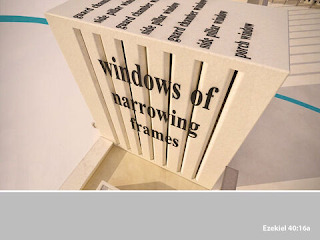
Haftarah- Ezekiel 43:10-27 Thoughts
Do you find Ezekiel a bit perplexing? If so, you are in good company. Early this morning, I fell asleep listening to
this commentary by Chuck Smith on the Blue Letter Bible website about Ezekiel 40-48. The author starts by admitting he feels uncomfortable commenting on this scripture. According to this author, the temple described in Ezekiel is to be built after the second coming of the Messiah, and this is what these blood sacrifices refer to as well. I wonder what the Jewish scholars say about this passage.
Since Ezekiel had this vision of a new temple just shortly after the destruction of the first temple, I wonder if this vision was initially intended to be the plan for the second temple.
I have seen some posts on social media that refer to passages in Ezekiel as proof that people should still be doing animal sacrifices, and to not be doing the sacrifices is dispensationalism.
I know that the scripture readings for today all point to the fact that sacrifices were made in the temple and that history indicates that after the temple was destroyed 40 years after the death of Yeshua, sacrifices could no longer be made.
However, I wonder why no one remembers the sacrifices that were made for many years before a Tabernacle was constructed. In Genesis, Cain and Abel brought sacrifices to Creator - no temple required.
It is interesting in Ezekiel that Creator emphasizes the cleansing of this new altar for sacrifices by sacrificing goats and bullocks on it for 7 days to purge it before offering sacrifices of atonement on it on the eighth day.
Haftarah- Ezekiel 43:10-27 Teaching Resources
Searching for "Ezekiel 43 kids" on Pinterest mostly results in dry bones resources. Searching "Ezekiel temple kids" did not result in many resources either. The focus for this week, though is on sacrifices. Still trying to find resources for Ezekiel's description of the sacrifices. Searching Pinterest for "Ezekiel sacrifices" is only resulting in more results about the temple.
New Covenant- Hebrews 13:10-16 Thoughts
It is clear to see how this scripture selection ties in with the Torah - in an oblique way, This selection explains how the sacrifices the priests made in the temple differ from the sacrifice of Yeshua. , and that He was outside the camp.
I think it was in this Hebrews 13 Commentary by David Guzik that I read a good explanation about why this was being written at this time to the followers of Yeshua. Oops! Not there! Somewhere I read that the followers of Yeshua had been banned from going into the temple - this was perceived as a really big problem! How could they be forgiven of their sins if they were not allowed to take part in bringing sacrifices to the temple?
Little did they know, but it wouldn't be long before the temple would be destroyed.
The line in Hebrews 13:16 where it says "these are the sacrifices that are pleasing to G-d" reminds me of another scripture that had been written centuries earlier about the sacrifices wanted by the Creator in Psalm 51:17 - a broken spirit and a contrite heart.
New Covenant- Hebrews 13:10-16 Teaching Resources
The teaching resources I have found so far for children are about Hebrews 3:16 highlighting the importance of learning to share.
- Teaching Children About Sharing 32 activities, This is not Bible-based, but it has some great research on how sharing benefits people.
- This children's video on Hebrews 13:16 focuses on sharing and has an action verse at the beginning that could easily be adapted to help children remember this scripture. Hebrews 13:16 And don't forget to do good and share with those in need. These are the sacrifices that please G-d (Hashem). The links to the colouring pages are no longer active, but the link to the children's bulletin is still active.
New Covenant - Romans 14 Thoughts
Romans 14 largely addresses the issue of arguments people were having about which day people should be worshipping and which foods people should be eating.
While I personally believe that there were some very good reasons Our Creator told the Israelites not to eat certain foods., it is and the tnot up to me to judge other believers in their choice of foods.
In addition, while I have been strongly led to do as set out in Ezekiel 20:20 stand sanctify Our Father's Sabbaths, it is not up to me to judge other believers who think differently. This is a matter between them and Our Creator. We need to love our neighbours as ourselves.
Our Saviour taught that" a house divided soon falls" and while He was speaking about accusati ons that He was casting out demons because He was an agent of evil, I believe this scripture definitely applies here too.
A good thing to do when we see contentions happening about the differing ways people praising Our Creator, we need to stop, drop , and roll!
1. Stop the contentious conversations, before it escalates.
2. Drop the topic.
3..Roll the conversation smoothlyinto something we can all agree on - like how wonderful Our Creator is.
New Covenant - Romans 14 Children's Ministry Teaching Resources
- Video Romans 14:19 NIRV Konnect HQ Memory Verse is a short clip with actions that could help children focus on this positive conclusion. This is the best resource I have found for children's ministry so far for use as is with Messianic children's ministry.
- Romans Study For Kids (Romans 14:1-12) | Proven Path Ministries (nicolelhvaughn.com) This lesson has some very good ideas that could be useful in creating materials for teaching children. Nicole includes questions that could help children apply the teaching to their lives. This lesson includes a reference to a video of Daffy Duck looking with contempt at Bugs Bunny - which could be a good way to explain the concept of not looking with contempt at other believers for how they worship.
- Video What is a Kingdom? Romans 14:7 Has a cute lion puppet in discussion with a young woman about Romans14:7. While it is meant to be used with children, much of the vobulary is quite complicated.
About This Author
Sister Su is grateful to God for keeping her alive. She is a Trent/Queen's Concurrent Education graduate with over 20 years of teaching experience. She writes on several blogs, has a YouTube channel and is most easily reached through Twitter @Sister_Su See her link tree for more details:
@Sister_Su | Linktree
This post was proofread with the free version of Grammarly


.jpeg)
.jpeg "Ezekiel Described This Temple")